
No products
Product successfully added to your shopping cart
There are 0 items in your cart. There is 1 item in your cart.
History: Peter Lynn Kiteboarding (PLKB)
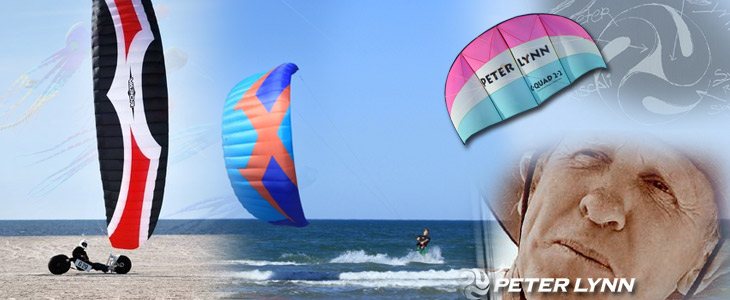
1946-1990: Origins and development: The birth of traction kites and kitesailing
Born in 1946, Peter Lynn loved flying kites from an early age.
He began his career as an engineer, graduating BE mech Hons in 1969 and working full-time in the field from 1971, since when he has always been a leader in innovation and a driving force in the international kite industry. With the sole aim of being on the "leading edge" of kite development, Peter and his team have an impressive list of innovations to their credit, including the Buggy in 1990, the C-Quad in 1997 and the Arc Style/Twinskins kites in 1999.
In 1990, Peter Lynn's invention of the Buggy showed for the first time that a kite could be a very practical means of converting wind energy into motive power. From then on, Peter and his group of designers devoted 100% of their time and energy to the development of traction and kitesailing.
One of the first wings to bear Peter Lynn's name was the Peel. With a very simple design, this two-line wing offered excellent performance, stability and handling. The Peel was launched in 1991 and was a huge success for over 15 years.
Although handicapped by the wings (the best performances at the time were achieved with enlarged delta-type wings), Peter and his team managed in just a few months to successfully sail all the races in winds from 10 km/h to, on one particular occasion, over 100 km/h. By 1988, they had successfully water-skied using the power of a wing, mastered towed ice-skating and even tried their hand at kiteboarding.
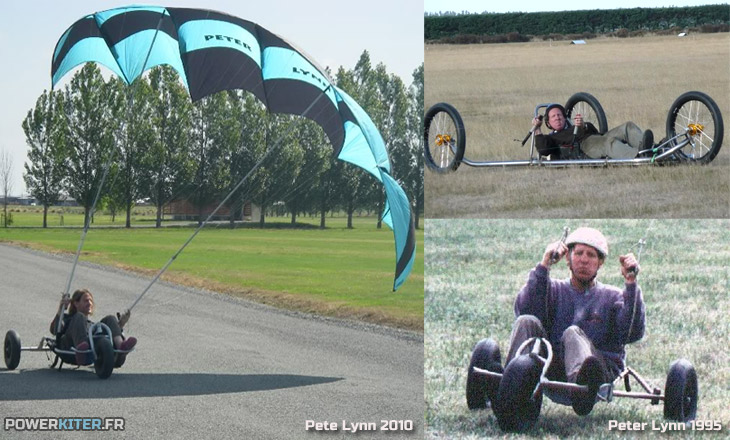
The invention of the modern Buggy in 1990 marked a breakthrough in traction kite development: kitesailing could continue in winter even when their favourite lake was frozen over, with the wheels replaced by 3 mini boat hulls. The result was immediately recognised as a manageable Buggy, and production began just a few months later, giving birth to what was to become a world-famous sport with perhaps tens of thousands of practitioners.
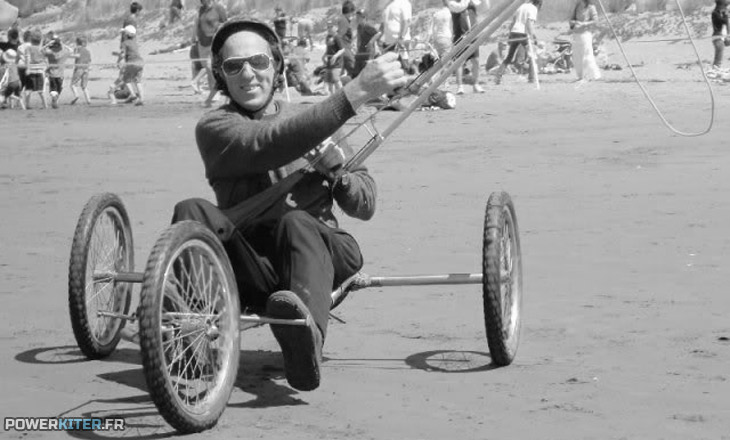
1990-1997: The first kite-buggies
As he continued to develop all kinds of Buggies, Peter Lynn tried to keep them as simple as possible. The main feature of Peter Lynn's classic Buggy, one of the very first to be marketed, was indeed its simplicity. By unscrewing just a few bolts, the Buggy could be adapted to the size and preferences of its user. The Buggy featured an extremely simple but cleverly designed seat, and the forks were made to fit only the smallest wheels.
The second generation Peter Lynn Buggy was far superior in terms of performance. From the classic thin-tube Buggy, Peter Lynn developed the much more elaborate "Competition" Buggy, which is still available for sale today.
Peter Lynn also developed a wide range of extensions and accessories for the Competition Buggy, from extended wheel axles to enlarged frames and extra-wide wheels for tandems. The first wheels used were perfectly suited to use on hard sand, but slowed down or stopped as soon as they encountered softer sand, forcing the rider to walk to a better spot. And so the Big Foot Buggy was launched! The big difference with other versions is its extra-large wheels, enabling riders to venture out on soft sand and uneven terrain. In addition to the wheels, the Buggy is also wider for greater stability.
Finally, the Folding was born last. The Folding is a Buggy whose main feature is that it can be disassembled without the use of any tools: ideal for storage in the car or at home. Aside from this aspect, the Folding is also an excellent freestyle Buggy, with a perfectly balanced centre of gravity and a particularly rigid frame.
As tricks became more and more extreme, riders began to do more freestyle, and a durable, solid design became necessary. The answer was the Competition XR Buggy, a more solid version of the Competition.
1997: The C-Quad
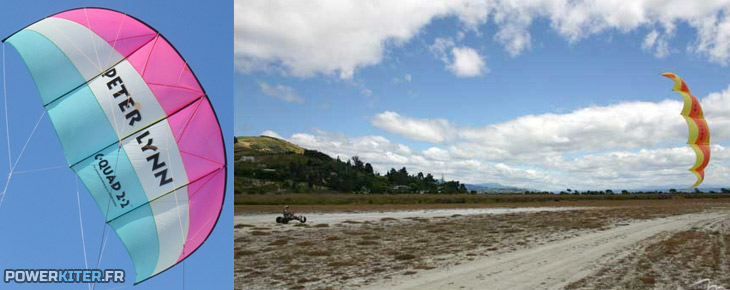
In 1997, the invention of the world's first hybrid traction kite, the C-Quad, with its great speed and performance, took traction kite users all over the world by surprise. The C-Quad quickly became widely used in many traction disciplines, proving perfectly suited to Buggy, kitesailing and kiteboarding.
The secret of this wing lies in the fact that Peter designed it to generate a minimum of drag while offering exemplary handling. A delta wing is very efficient with little drag, but large deltas require larger diameter tubes and are therefore relatively expensive and difficult to transport. Conversely, a foil is much easier to handle and transport, and it is simpler to build large foils.
The C-Quad is an excellent blend of two wing types, combining the single skin of a hang glider with the bridles of a foil. The wing, supported by the entire structure, requires only a 4mm frame, even for the biggest versions like the C-Quad 10 m². The four-line system is also a mix of delta and foil, making the wing ideal for high-speed buggy riding.
In some places, Peter Lynn's C-Quad is still used in Buggies competitions, and the performances are still top-notch!
1999-2004: The arched wings
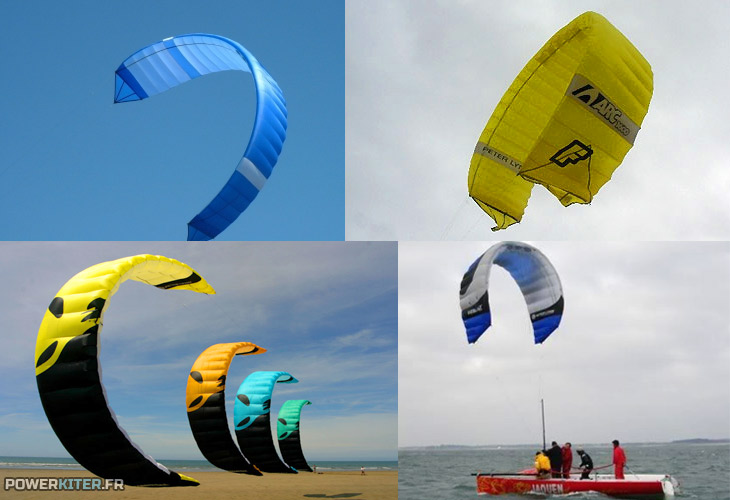
1999 saw the launch of a revolutionary new product from Peter Lynn. The Arc is a new-style wing, in simple terms, a foil without bridles. This new style of wing features incredible flying qualities and in particular a stability that no other style of wing has ever matched. You can fly a Peter Lynn Arc overhead and run straight ahead until you are out of breath, and the wing still won't run away.
The standard Arc is an incredible kite, totally re-launchable in the water, which surprised the kiteboarding world with an approach absolutely different from any other brand.
The standard Arc was followed in 2002 by the F-Arc, a high-ratio wing designed for riders looking for a good hangtime. Its design is not for the faint-hearted in a rapidly expanding market with more and more radical brands.
2003 saw the launch of the Peter Lynn Guerilla, a wing that proves that performance and handling are not mutually exclusive. The Guerilla offers excellent depower and very good lift, making it a versatile freestyle wing.
In early 2004, two new models were introduced. The Guerilla II brings more lift and improved speed. The Bomba is a new kite for waves and wakestyle.
In 2004, Peter Lynn introduced a radical new wing design, the Phantom. With a high aspect ratio of 6.5, the Phantom is a new type of wing for land traction. Many people are seduced by this Twinskin with its incredible lift and the possibility of using a single wing to cover a wind range usually covered by two or three foils.
2005-2013: Democratisation and high performance
Over the years, Peter Lynn's in-house product designers in the Netherlands became key to the development of the range. Twinskins made a significant breakthrough and foils changed considerably. By taking advantage of new design techniques and research into cell manufacturing, Peter Lynn products pushed the possibilities to new standards.
In 2005, the Peter Lynn Pepper surprised the beginner wing market by becoming the ideal wing for those wishing to start traction. The Pepper is easy to use with its two lines, while offering great stability and power.
After this great success, Peter Lynn developed a wide range of products for beginners to intermediate users who want to progress easily in their favourite sport.
This range is called the Access Range. The Hornet, Twister '08, Twister II and Viper allow all those who want to start, progress and push their limits, whether with a buggy, a mountainboard or even a snowboard. Each kite is designed with a specific goal in mind: maximum stability for beginners, lift for freestylers or speed for land yacht pilots.
In 2006, the first wing in the "Pro Range" was launched: the Reactor. This excellent wing was developed for competition and speed in Buggy, mountainboard and snow. The Reactor flies very fast while remaining extremely stable and forgiving. It is the first wing to be designed according to the Peter Lynn Pro Range criteria, which offers the most demanding riders the very best in manufacturing techniques, materials and finish. Peter Lynn once again sets the bar very high, defining new quality standards.
In 2009, a superb, high-performance all-round traction wing was added to the Pro range: the Core. This high-quality yet very accessible wing is the result of the very best technical development technologies from the Dutch designers at Peter Lynn. A model of expertise that marks the first step towards what the Pro range will henceforth be: ultra-high-performance, accessible wings.
2010 is a landmark year for the New Zealand brand, which launches a kite that will definitively establish Peter Lynn as the specialist in high-performance kites for land yachting: the Vapor. In less than 3 years, in the hands of the world's best pilots, the Peter Lynn Vapor climbed to the top of every podium, winning 2 world titles and numerous world speed records in land yachting. Even today, this kite remains one of the most popular buggy kites for racing and speed pilots.
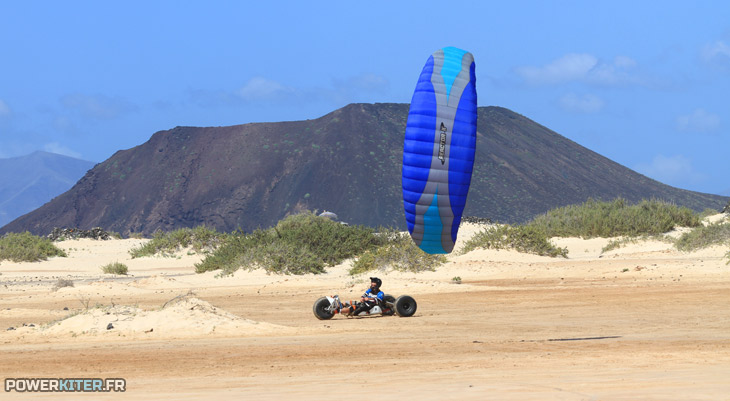
2013 marks the launch of the 3rd generation for most wings in the Peter Lynn range. Models such as the Hornet, the Impulse and the Twister, all real commercial successes, are renewed with new technical improvements. More than ever, Peter Lynn offers beginners high-quality products to discover the joys of traction.
2013 to 2018: Kitesurfing and inflatable kites
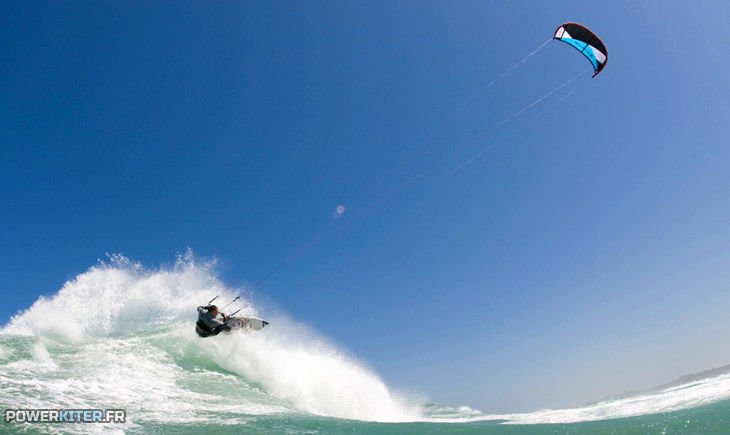
But above all, 2013 marked a new milestone for Peter Lynn with the launch of the brand's first two inflatable kitesurf kites: the Escape and the Fury. Faithful to its commitments, these new products are the fruit of many years of work, resulting in models designed using the finest materials and the most advanced manufacturing techniques.
The Escape and the Fury received a new version in 2014, alongside two other new additions to the range: the Fury Lite, dedicated to light wind, and the Swell, the first wave kite made by Peter Lynn.
2019-2021: Peter Lynn Kiteboarding becomes PLKB
Between 2018 and 2019, Peter Lynn Kiteboarding began a reflection on its brand identity and officially adopted the name PLKB in 2021, an acronym for Peter Lynn KiteBoarding. This rebranding coincided with the brand's 50th anniversary and the arrival of new management. The goal: to project the brand into the future while preserving the Peter Lynn heritage. The company is now based in the Netherlands.
Under the PLKB name, the range was expanded and modernised while retaining the brand's DNA: robust, accessible and high-performing kites built to last. The iconic Access range models were thoroughly updated to meet today's demands.
2026: PLKB evolves into Cross Kites PRO
In 2026, Equipe-Trading, the Dutch company behind the Peter Lynn and PLKB brands, decided to unify its premium range under a new name: Cross Kites PRO. But this is more than a label change. It is an opportunity for the manufacturer to revisit each model in depth, improving airfoil designs, materials and safety systems.
The Impulse TR is a clear example of this evolution: a newly developed airfoil delivers noticeably better performance in lighter winds and a more dynamic flying experience. The kite recovers more easily after a crash, and is much less likely to overshoot the edge of the wind window, one of the classic weak points of trainer kites. The canopy is built from lightweight yet highly durable 40D nylon. The control bar has been redesigned with a stronger safety system, and the stitched Dyneema bridles and lines, a long-standing strength of the brand, are carried over to ensure durability and precision.
The iconic models are not disappearing, they are changing their flag and improving. The Peter Lynn Hornet becomes the Cross Kites PRO Hornet. The Twister, the Impulse, the Hype TR: each continues its journey under this new label, revised and refined, with a renewed commitment to technical quality.
Powerkiter.fr supports this transition by offering both generations: the last Peter Lynn / PLKB models still in stock alongside the new Cross Kites PRO kites. If your favourite model has changed its name, it has not changed its character, and in many cases, it is now better.
The essential kites, yesterday and today
The Cross Kites PRO Impulse (formerly Peter Lynn Impulse) is the benchmark 3-line bar trainer kite. New airfoil with improved light-wind performance, easier relaunch after crash, 40D nylon canopy, redesigned bar with stronger safety system, stitched Dyneema bridles: the kite to choose when learning bar control before moving on to kitesurfing or mountainboarding.
The Cross Kites PRO Hornet (formerly Peter Lynn Hornet) remains the safe choice for beginners and improvers, available in a bar version and a handles version. Robust, stable and forgiving, revised for the CX PRO range: the kite we recommend without hesitation for demanding beginners in buggy and mountainboard.
The Cross Kites PRO Twister (formerly Peter Lynn Twister) is the reference kite for first jumps, available in a bar version and a handles version. Powerful, with plenty of lift, the only true jump kite in the beginner range, renewed under the CX PRO label.
The Cross Kites PRO Hype TR (formerly Peter Lynn Hype TR) is the top pick in our 2-line bar selection, ideal for children and lighter riders discovering traction kiting safely.
Find the full Cross Kites PRO range at Powerkiter
Powerkiter.fr has been an official Peter Lynn / PLKB / Cross Kites PRO dealer in France for over 10 years. Browse the full range with expert advice to find the right kite for your level and discipline.
→ View all Peter Lynn / PLKB / Cross Kites PRO products
> Official website: Peter Lynn Kiteboarding
> Back to: Powerkite brands
> Shop: view all Peter Lynn products