
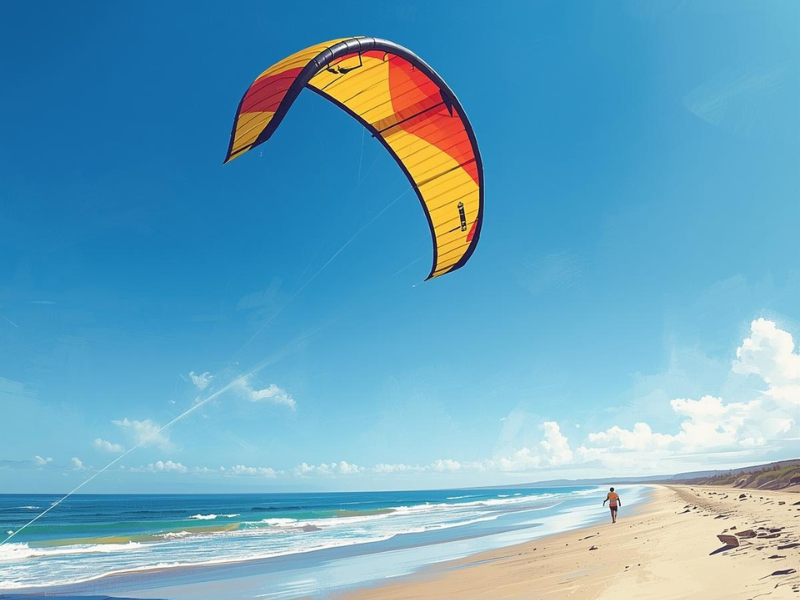
What is a power kite?
Unlike a traditional kite designed purely for leisure or decoration, a power kite is built to generate pulling force using the wind.
This traction can be used to:
ride with a kite mountainboard
glide over snow while snowkiting
- or simply experience the force of the wind in static flying, for example performing jumps and tricks on the beach!
Most modern models are ram-air foil kites, capable of producing significant traction while remaining relatively easy to control.
For beginners, the goal is not to seek maximum power but rather stability and ease of control.
Common beginner mistakes
When choosing your first power kite, certain mistakes are very common.
Choosing a kite that is too large
This is probably the most common mistake. A large kite generates much more power and can quickly become difficult for a beginner to control.
It is better to start with a reasonable wing size and upgrade later to a larger kite if needed.
Underestimating wind power
Even a modest-sized kite can generate significant traction when the wind increases. The size you choose should always take into account the typical wind conditions.
Choosing a model that is too technical
Some kites are designed for performance or competition. They are often faster and more demanding to fly. When starting out, it is better to choose a stable and forgiving model.
What size power kite should beginners choose?
Kite size is expressed in surface area (m²). The larger the surface area, the more traction the kite will generate.
For beginners, the following sizes are generally recommended:
1.5 to 2 m²: ideal for discovering kite control and learning the basics
2 to 3 m²: a good balance for learning while starting to feel real traction
3 to 4 m²: suitable for heavier riders or lighter wind conditions
The ideal size also depends on:
the pilot’s weight
the wind strength
the terrain where you practice
On a beach or a large open field, a kite between 2 and 3 m² is often an excellent choice for beginners.
2-line or 4-line kite?
Another important criterion is the number of control lines.
2-line kites
These are the simplest models.
They are controlled using a bar or handles and allow you to:
learn flight paths
understand the wind window
discover the sensations of traction
They are often easier for beginners.
4-line kites
Four-line models provide greater control:
better power management
the ability to brake the kite
more precise control
They are particularly popular for:
kite buggy
mountainboarding
snowkiting
For a first experience, many riders start with a stable 2-line kite before moving on to a more versatile 4-line kite.
Important features for a beginner power kite
Some criteria are particularly important when choosing a beginner-friendly kite.
Stability
A stable kite stays well positioned in the wind window and does not stall easily. This makes learning much easier.
Progressive power delivery
Progressive traction helps avoid sudden reactions. This is essential for maintaining control.
Durability
Your first sessions often involve a few crashes. A strong and well-built kite will better withstand these small accidents.
Easy relaunch
Some kites relaunch very easily after touching the ground, which is particularly useful for beginners.
Some good beginner kite models
Several kites are well known for their accessibility and ease of use.
Peter Lynn Impulse
The Impulse range is very popular for beginners. These kites are known for their stability and ease of control, making them an excellent choice for first sessions.
Peter Lynn Hornet
The Hornet series offers slightly more traction while remaining very accessible. It is a good compromise for those who want to quickly experience the power of the wind.
HQ Beamer
The Beamer is a more versatile kite often used for kite buggy or mountainboarding. However, it still remains relatively accessible for motivated beginners.
Some tips for getting started
To fully enjoy your first power kite, a few simple tips can make a big difference.
choose a wide open area
avoid strong winds
wear gloves to protect your hands
start by learning the basics of kite control
It is also recommended to practice with a friend or an experienced rider during your first sessions.
Ready to get started with us?
Choosing your first power kite is an important step to start this discipline properly. By selecting a stable, easy-to-control kite of reasonable size, you will quickly progress and fully enjoy the sensations provided by the wind.
Once the basics are mastered, you can always move on to more powerful or technical kites suited for activities such as kite-mountainboarding or snowkiting.
The most important thing is to start with equipment adapted to your level in order to discover power kiting safely and with maximum enjoyment.
